
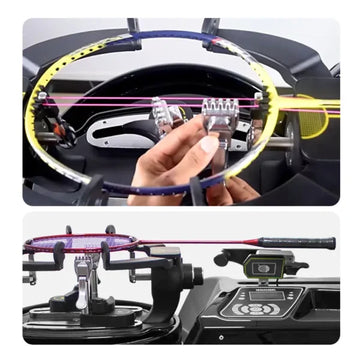
Badminton racket stringing
At Fjerboldshoppen, you can have your badminton racket restrung if the unfortunate happens and your strings break. Among other options, you can purchase a new stringing with BG65, Aerobite Boost, BG66 or BG80, which are the most popular strings in Denmark. We have extensive experience in restringing badminton rackets and we are ready to help if you are unsure which string to choose. See our selection of badminton strings and restringing prices below.
BG 65/66 – 0.70 mm: DKK 145
BG 80 – 0.68 mm: DKK 145
Yonex Aerobite – 0.61 mm: DKK 145
If you are unsure, and whether you are a beginner or an advanced player, our standard advice and the absolute most common stringing is: 10.5 kg with BG80 in 0.68 mm.
NOTE: All restringing is at your own risk, especially if there are cracks or large scratches on the racket. If you are unsure whether your badminton racket can withstand being restrung, you should always consult us before restringing begins.
When will my racket be ready after I drop it off?
Once you drop off your racket with us, it is typically ready for pick-up 2-3 days later. During peak periods, longer waiting times may occur, but we will, of course, notify you if that is the case. Our stringers have extensive experience in badminton, so your rackets are in safe hands with us.
How tight should the stringing be?
In badminton, most strings are between 9-13 kg in tension. In relation to soft versus hard strings, the number of kilos in a stringing is as follows:
- Soft stringing: 9-11 kg
- Medium-hard stringing: 11-12 kg
- Hard stringing: 12-13 kg
There are also extremes that are softer or harder than the above classification. Many professional badminton players have their rackets strung with a tension of up to 15 kg. With such a hard stringing, it requires you to hit the shuttlecock incredibly precisely and consistently, as the sweet spot becomes significantly smaller. In addition, the strings also break much easier, not least if you hit the shuttlecock on the edge of the racket head.
Some players also choose to have different tensions in "cross and main," i.e., the strings across and lengthwise, but that is truly at an expert level. Unless you have incredibly specific requirements, you don't need to go into such detail.